
Frost- and weather-resistant facade – what the National Technical Assessment states
According to the National Technical Assessment A-62/2025, the Facade Board's weathering resistance is class "A": freeze–thaw, heat–rain, wet–dry and water permeability.
- facade-board
- technical
A facade has to cope with everything the year brings: frost and thaw, summer downpours on a sun-heated wall, weeks of rain and then drying out again. Whether cladding still looks intact, flat and orderly years later depends on how it handles these recurring loads. For the Facade Board the answer is not a promise but a document: the National Technical Assessment A-62/2025. Here is what it states – and what to watch for so that the facade performs well in the long run.
What does a facade go through in a year?
In Hungary, facades often freeze again at night after a daytime thaw in winter. Water on the surface and in the pores expands as it freezes, and year after year this gradually breaks weaker materials apart. In summer a sudden cold shower hits the sun-heated wall, and in autumn and spring wet and dry periods alternate. A facade is tested not once, but again and again.
If a cladding material cannot cope with these cycles, it shows on the facade:
- the surface crumbles, flakes or becomes blotchy,
- board edges chip and cracks appear around the fixing points,
- the joints lose their straight lines and the facade looks untidy.
What does the National Technical Assessment state?
The "TT ventilated facade cladding system" built with the Facade Board holds a National Technical Assessment (NMÉ A-62/2025), issued by ÉMI and valid from 22 May 2026. According to the document:
- weathering resistance: class "A" – the assessment covers freeze–thaw, heat–rain, wet–dry and water permeability
- bending strength: at least 13 N/mm² (category A, class 3)
- density: 1510 ± 150 kg/m³
- fire classification: A1, non-combustible
The weathering tests model exactly the effects a Hungarian facade faces in a year: alternating freezing and thawing, rain on a hot surface, wetting and drying, and water passing through the board.
Why bending strength matters too
A facade board is loaded not only by the weather: wind pressure and suction, temperature changes and the areas around the fixing points all stress it. Bending strength shows how much bending load the board can take before it breaks – according to the National Technical Assessment, at least 13 N/mm² for the Facade Board. The density (1510 ± 150 kg/m³) indicates a compact, uniform material structure.
Practical tips for a durable facade
Even the best material only performs fully when installed properly:
- Store the boards dry, lying flat and protected from rain.
- Build to the NMÉ system: stainless-steel rivet fixing on L or T aluminium profiles, with a ventilated cavity.
- Keep the planned open joints between the boards and do not force the board onto the substructure.
- Choose the thickness (8, 9, 10, 12 or 15 mm) together with the designer, based on the fixing method and the substructure spacing.
Where is it worth using?
Because the board works outdoors all year round, exposed to the weather, it can be used in ventilated facade systems on low- and high-rise buildings alike: on family homes, residential, commercial and industrial buildings, in facade renovations, and as cladding for balconies, loggias and soffits. The colour runs through the whole board, so the facade never needs painting.
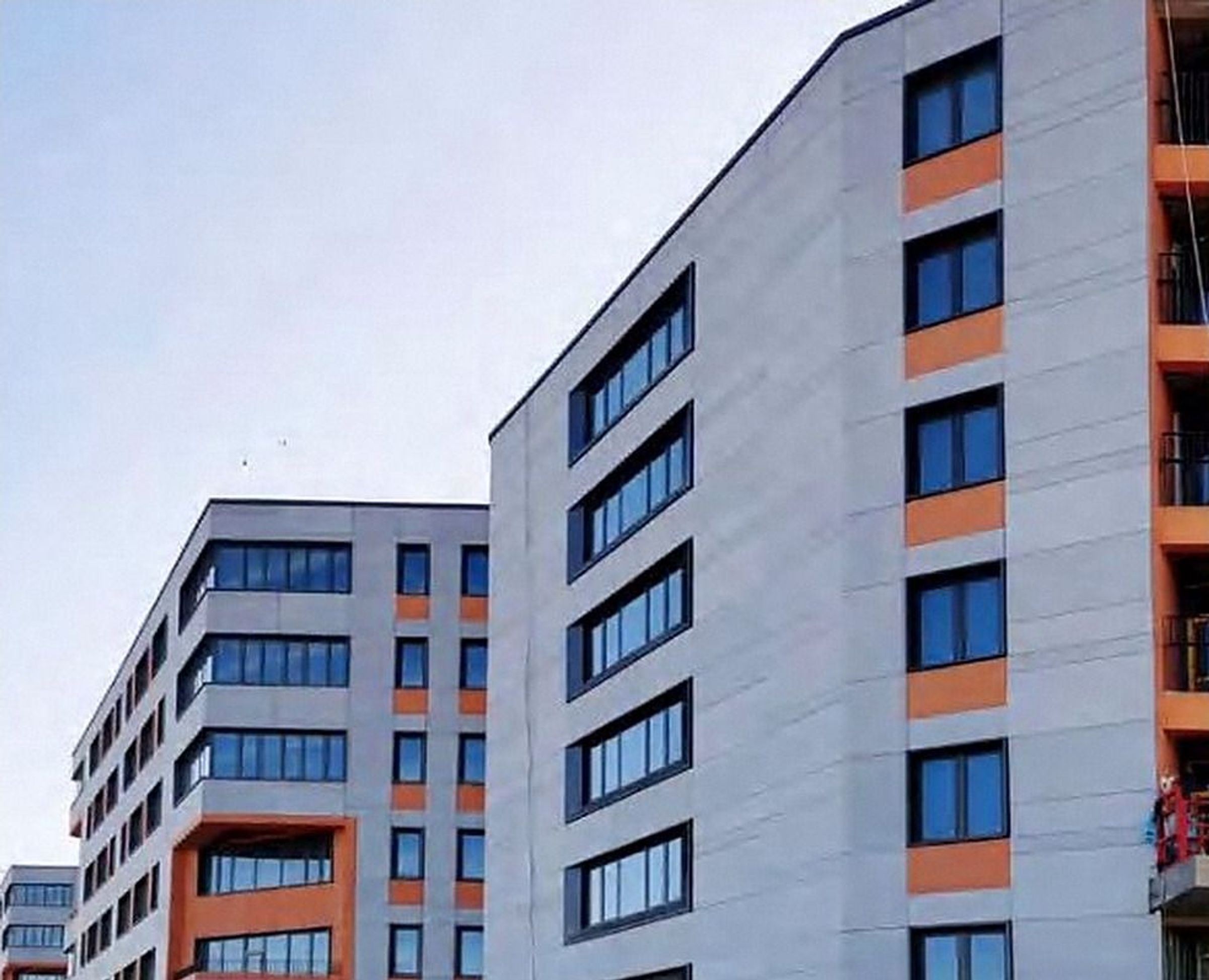
The cover photo shows an international reference project.
We are happy to send technical data sheets to designers and contractors. Write to info@tomzol.com or call: +36 30 959 6537