
Fire protection without compromise
The Facade Board is classified A1 according to EN 13501-1, so it is non-combustible – and the fire performance of the complete facade system has also been verified.
- facade-board
- fire-safety
- technical
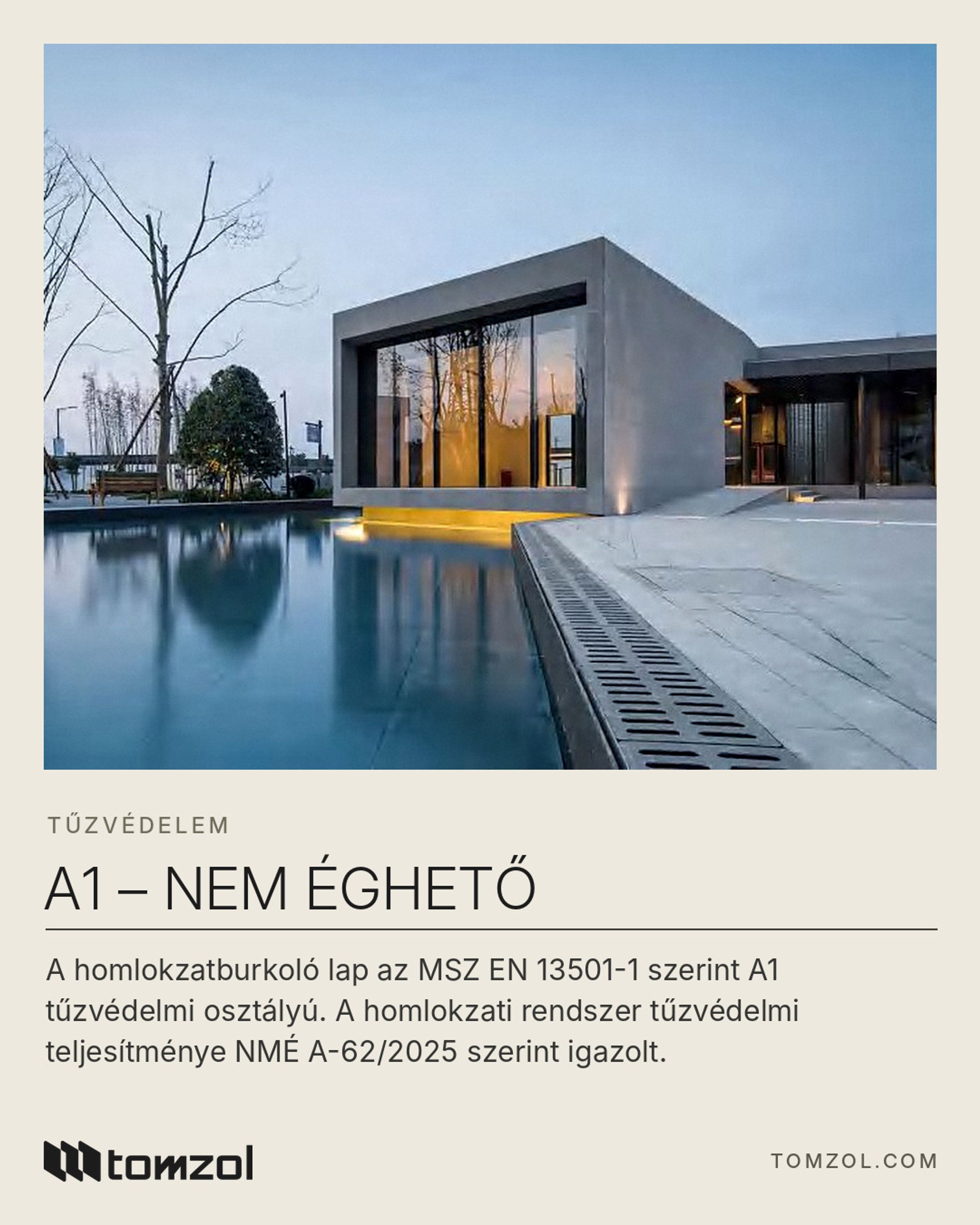
The facade is a building's largest surface, so it plays a key role in fire safety: combustible cladding can help a fire spread from floor to floor. Fire safety is an area with no room for compromise, and the right decision is best made at the design stage. The Facade Board is classified A1 for reaction to fire according to EN 13501-1 – in other words, it is non-combustible. In this article we explain exactly what that means, why testing the board alone is not enough, and what to look out for in design.
What does class A1 mean?
The EN 13501-1 standard classifies construction products according to their reaction to fire. The scale starts at A1 – the most favourable class, reserved for non-combustible materials – and moves towards more combustible materials. An A1 material does not contribute to the spread of a fire and does not feed the flames.
For fiber cement this comes from the nature of the material: the board is a cement-bonded, mineral-based material that does not burn. The pigment that gives the colour is mixed into the material too, so there is no paint or plastic coating on the surface that could form a combustible layer.
It is not just the board: the complete facade system
In a fire, a facade always behaves as a system: the cladding board, the fixings, the substructure and the insulation all matter. That is why we did not stop at the material classification for the Facade Board – the fire performance of the complete facade system has also been verified (Hungarian national technical assessment NMÉ A-62/2025):
- with bonded fixing: fire spread limit Th ≥ 15 min
- with bonded fixing plus supplementary mechanical fixing: fire spread limit Th ≥ 45 min
Th is the facade fire spread limit: it indicates how long the facade construction can prevent a fire from spreading further across the facade. The higher the value, the greater the safety margin. The values apply to construction in line with the system specifications.
So it is worth thinking on two levels. Class A1 is about the board: the material itself does not burn. The Th value is about the whole facade: how the board, the fixings and the substructure behave together in a fire. Together they give the full picture, and both are needed for a facade to be truly safe.
What to look out for in design and construction
- Decide on the fixing method early in the design – bonded and combined (bonded plus supplementary mechanical) fixing give different fire spread limits.
- The fire performance only applies if the facade is built in line with the system specifications – the substructure, the fixings and the detailing are all part of this.
- In a ventilated facade, the air gap behind the cladding is important for moisture control; its fire safety details must be resolved by the designer in line with the system.
- Ask for and keep the documentation – it may be needed for permits and at handover.
Where is it especially important?
Non-combustible cladding is worth considering on any building, but there are situations where it matters most: multi-storey residential buildings, office buildings, commercial and industrial buildings, and facade renovations where old cladding is replaced with a more up-to-date solution. The same board can also be used on balconies, loggias and soffits, so the whole building can have uniform, non-combustible cladding.
Alongside fire safety, the board makes no compromises in its other properties either: it is through-coloured, frost-resistant, and available in 10 colours with several surfaces.
We are happy to discuss the details with designers and contractors. Write to info@tomzol.com or call us: +36 30 959 6537