
The look of wood, without the maintenance
The Wall Plank has the grain of cedar wood but is made of fiber cement: it does not rot or go mouldy, and pests cannot damage it.
- wall-plank
- reference
A timber facade is warm, friendly and timeless – but anyone who has lived in a wood-clad house knows it needs sanding, oiling or painting every few years. The Wall Plank gives you the look of wood without the maintenance. Here is what it is made of, why it does not rot, and what to keep in mind if you install it yourself.
Why does wood rot – and fiber cement not?
Wood is destroyed by moisture and the fungi, mould and insects that follow it: organic material is food for them. The Wall Plank is a Portland-cement-bonded, cellulose-fibre-reinforced board in which the fibres are fully encased by the cement matrix. According to the manufacturer, its service life is comparable to that of concrete: it does not rot, go mouldy, crack or delaminate, and pests cannot damage it.
What is it made of?
Portland cement, lime, quartz, cellulose fibre, additives and water. It contains no asbestos, glass fibre or formaldehyde. It resists UV radiation, rain, frost and chemical influences, and achieved the highest class in the ASTM E84 fire test.
Sizes, surface, colours
- Sizes: 3050 × 192 and 3050 × 241 mm
- Thickness: 7.5 and 9 mm
- Surface: lifelike cedar wood grain
- Colour: uncoloured as standard; also available factory-primed and coated in 32 shades
The factory primer gives the colour an even, durable base, so the facade is finished as soon as it is installed – no painting on site.
Where can it be used?
- Outdoors on facades of buildings up to 15 metres high: detached houses, terraced houses, holiday homes, garden and park buildings
- A continuous wall section should be at most 30 metres long
- Indoors it is also suitable as decorative cladding for partition walls and ceilings
Thanks to its low weight it also works well on existing buildings – the additional load on the structure is negligible.
Installation tips
Smaller areas can be clad as a self-build project after a short introduction; for large areas, an experienced contractor is the better choice. A few key rules from the manufacturer's guide:
- The substructure is galvanised steel or aluminium alloy; the planks are fixed with galvanised self-tapping screws or stainless steel rivets.
- Do not install in stormy or wet weather. Only dry planks may be installed: dry wet planks indoors, in a ventilated room, for at least 48 hours – never stacked.
- The temperature during installation should be between −10 and +35 °C, and between +8 and +32 °C for factory-primed planks.
- Store them protected from moisture on a flat, firm base, at most 2 metres high. Full-length planks should be carried by two people, on edge.
- Use an electric circular saw for straight cuts and a jigsaw for curves. Wear a dust mask when cutting and work outdoors where possible.
A photo from around the world
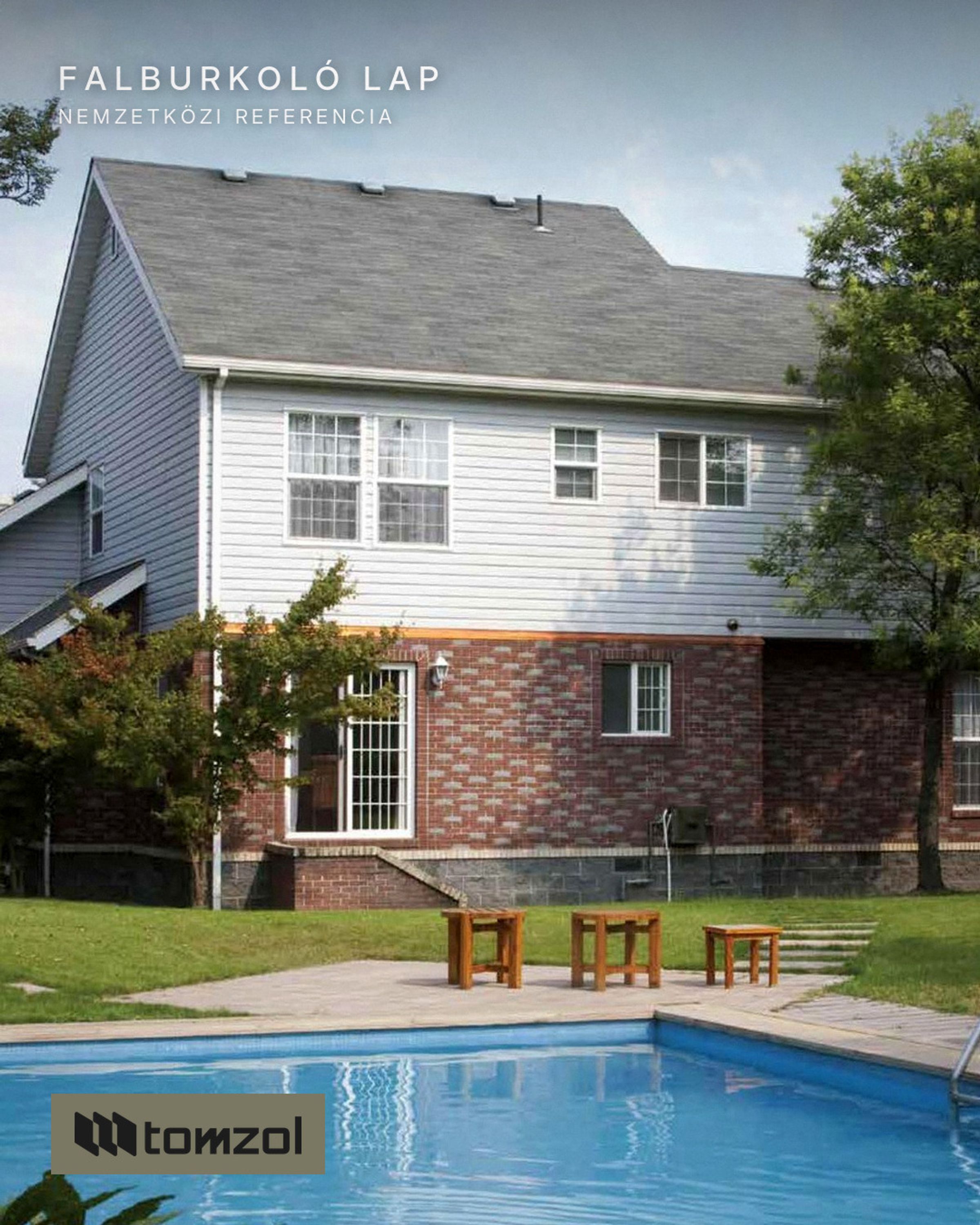
The house in the photo is an international reference project: it shows how well the cedar-grain plank works on a simple, clean-lined building.
For details and a quote, write to info@tomzol.com or call us: +36 30 959 6537. More information: tomzol.com