
A tiled finish is only as good as its base
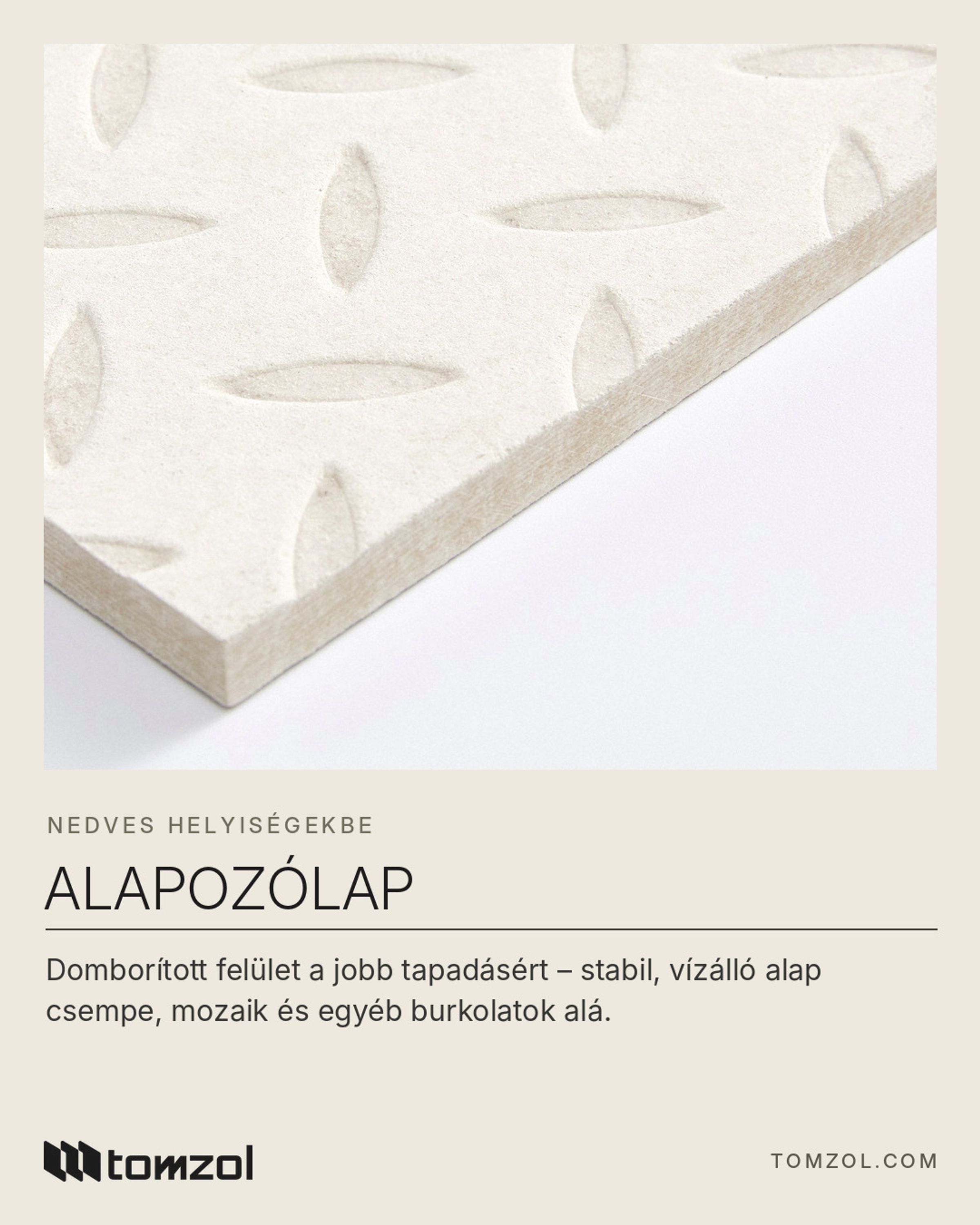
The Backer Board is an embossed fiber cement board made for tiles, mosaics and other finishes – the embossing gives the adhesive a better grip.
- backer-board
- interior
A beautiful tiled finish is judged by its joints, its pattern and its colours. What nobody sees is the base behind it – yet in the long run, that is what decides whether the tiling still looks flawless years later, or whether cracks, loose tiles and mould stains start to appear. In this article we introduce our Backer Board and explain what to look for when choosing a base for tiles in a wet room.
What is the Backer Board?
The Backer Board is a fiber cement board with an embossed surface, made specifically for use under tiles, mosaics and other finishes. The embossing gives the adhesive a better grip, and the board is water-, moisture- and mould-resistant. It is not there to be seen – it is there to keep what is seen intact: a stable, flat and durable substrate for whatever goes on top.
Key features of the board:
- Size: 2440 × 1220 mm
- Thickness: 9 and 12 mm
- Fire class: A1
- For bathrooms, showers, kitchens and other wet rooms
Why an embossed surface?
Tile adhesive works best when it has something to hold on to. On a completely smooth, closed surface the adhesive bed can separate more easily, especially where the tiling is regularly exposed to water, steam and temperature changes. The embossed surface of the Backer Board gives the tile adhesive a larger contact area and a mechanical key, so the finish stays firmly in place.
This matters especially for large-format tiles and mosaics: with the former because of the weight of each tile, with the latter because of the many small pieces and the dense grid of joints – both need an even, well-bonding base.
Water, steam, mould – the wet-room test
Bathrooms and kitchens are the most demanding rooms in a home: every day they face splashing water, humidity and rapid temperature changes. A moisture-sensitive base can swell and deform under these conditions, and mould can start to grow unnoticed behind the tiles.
The Backer Board is water- and moisture-resistant, mould-resistant and antibacterial, so it provides a reliable base even where conventional, moisture-sensitive materials quickly wear out. Fiber cement is also a cement-bonded mineral material – according to the manufacturer's data, its moisture movement is at most 0.25 %, and it is 100% asbestos-free.
Practical installation tips
- Choose the thickness to suit the application: when deciding between 9 and 12 mm, consider the stud spacing, the weight of the finish and the demands of the room together with the designer or contractor.
- The large 2440 × 1220 mm board size means fewer joints – faster installation and fewer weak points across the surface.
- Treat board joints and connections – especially where the shower meets the floor – according to the requirements of the waterproofing system you use.
- Use a tile adhesive suited to the finish and recommended for wet rooms.
- The Backer Board is not only for tiles: wherever a flat surface is needed for wallpaper or paint, it does the job too.
A bit of material history
Fiber cement was patented around 1900 by the Austrian Ludwig Hatschek, and it has remained one of the most versatile board materials in construction ever since. Today it is made with cellulose fibre reinforcement and without asbestos – and the same technology that protects our facades from the weather also performs behind the tiles in a bathroom. The Backer Board's A1 fire class means it is non-combustible, an added measure of safety indoors as well.
For tilers and contractors
Whether you are working on bathroom renovations, new apartments or larger construction projects, the Backer Board lets you solve the base under tiles in wet rooms with a single, easy-to-handle material.
Tilers and contractors: for a project-specific quote, write to us at info@tomzol.com or call: +36 30 959 6537